Rodent roofline exclusion prevents roof rats from entering the thermal envelope of coastal residences through roof-to-fascia gaps, tile transitions, and soffit return vents. In coastal Collier County, properties near…
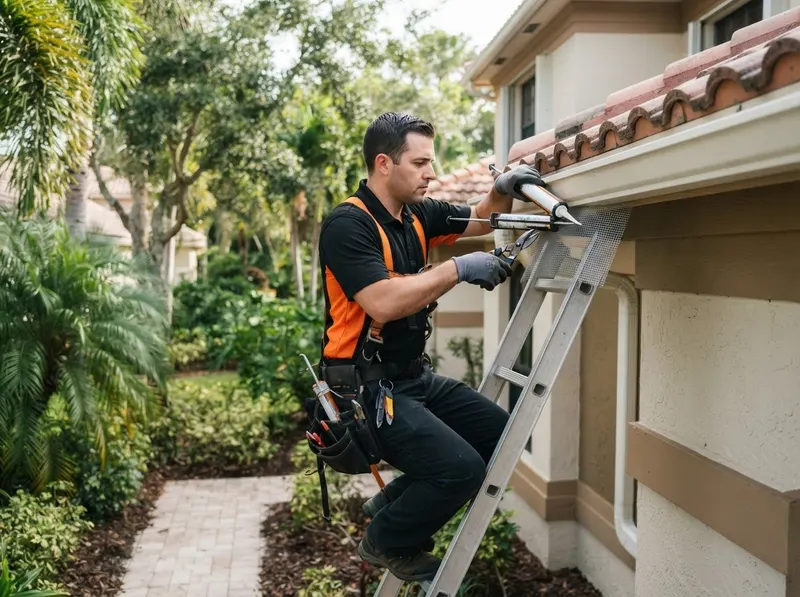
Rodent roofline exclusion prevents roof rats from entering the thermal envelope of coastal residences through roof-to-fascia gaps, tile transitions, and soffit return vents. In coastal Collier County, properties near waterways like Gordon River and Moorings Bay feature lush, mature vegetation including royal palms, gumbo limbo trees, and bougainvillea that create natural bridges to second-story architecture. Roof rats exploit architectural gaps as narrow as 1/2 inch to bypass ground-level pest defenses and settle inside attic insulation. Standard poison stations placed along the turf perimeter fail to prevent roofline incursions because roof rats travel almost exclusively off the ground. Mechanical exclusion replaces recurring exterior baiting by sealing the entry points permanently with chew-proof materials.
Tile roofs prevalent across Old Naples, Port Royal, and Aqualane Shores require specialized roof-tile ridge and eave closures. The curved voids beneath Spanish and mission barrel tiles provide rodents with sheltered runways that open directly into the attic deck. Proper exclusion inserts customized 23-gauge galvanized wire mesh or tailored sheet metal behind the fascia line, preventing wildlife entry without restricting essential roof deck ventilation. In neighborhoods like Pelican Bay, Coquina Sands, and Tiburon, where home profiles incorporate decorative moldings, boxed soffits, and custom stucco details, exclusion hardware is countersunk or hidden behind trim reveals to maintain architectural lines. In sprawling multi-acre residences across Golden Gate Estates, roofline exclusion also protects detached garages, guest casitas, and outdoor kitchen rooflines from native woodrats.
Decision guidance depends on the structure's entry dynamics. If attic noises occur strictly between sunset and dawn near the roof peak, roofline mechanical exclusion provides permanent resolution where attic fumigation or interior trapping alone cannot. Trapping without exclusion creates an ongoing cycle: removing one family leaves scent trails that draw neighboring colonies into the same soffit gaps within 30 to 60 days. The trade-off of whole-perimeter exclusion is higher initial labor compared to standard ground baiting, but it eliminates chemical residues, prevents dead rodents decomposing behind luxury wall finishes, and stops structural wiring damage permanently.
Every job gets a firm, written price after a free on-site visit.
Tell us about your rodent roofline exclusion job in Naples and we'll send a clear, written quote, usually the same day.
 Old Hickory Pest Control