Subterranean termite pressure in Southwest Florida remains active year-round due to the sustained humidity, sandy coastal soils, and elevated water tables of Collier County. Both native subterranean termites and…
Subterranean termite pressure in Southwest Florida remains active year-round due to the sustained humidity, sandy coastal soils, and elevated water tables of Collier County. Both native subterranean termites and invasive Formosan subterranean termites establish massive underground colonies, constructing exploratory mud shelter tubes across foundation stem walls, lanai footers, and plumbing penetrations. In communities like Port Royal, Aqualane Shores, and Old Naples, moisture-dense environments adjacent to Naples Bay and the Gulf of Mexico accelerate foraging activity beneath custom hardwood installations, subfloors, and structural framing. A continuous perimeter barrier stops this underground ingress by applying a non-detectable termiticide into the soil, creating a continuous zone where foraging worker termites unknowingly contract and transfer the active chemistry through social food-sharing and grooming, eliminating the central colony rather than merely repelling it.
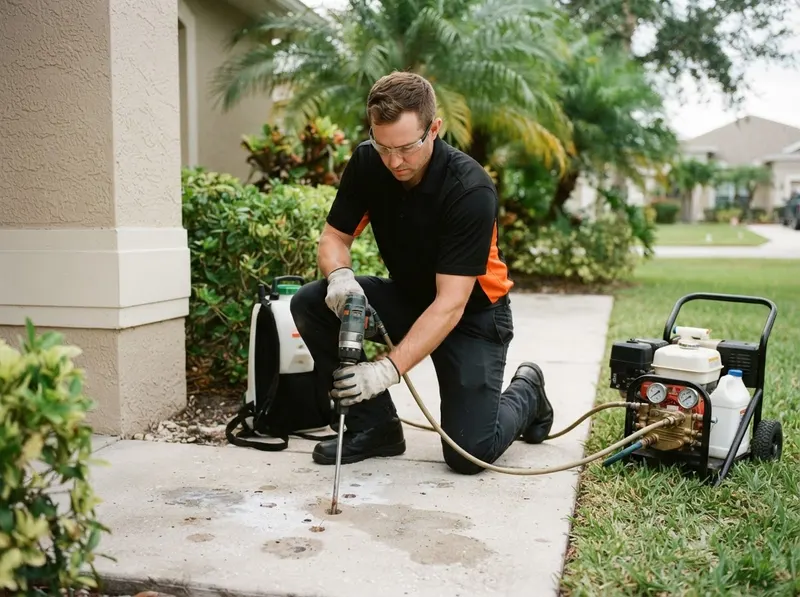
Selecting a perimeter liquid barrier versus an exterior in-ground bait station system depends on the structural foundation and surrounding landscape configuration. For homes in Pelican Bay, Moorings, and Park Shore featuring extensive flagstone, continuous marble patios, or enclosed lanais abutting structural walls, a hybrid protocol resolves physical access limits. Technicians drill through select mortar joints or expansion seams using low-vibration masonry bits to apply protective treatments under the slab without displacing high-end pavers or cracking delicate tile. Conversely, acreage parcels in Golden Gate Estates characterized by sandy pine flatwoods and broad landscape perimeters benefit from networked termite bait stations placed every 10 to 15 feet along the drip line. While liquid barriers deliver immediate zone saturation within 24 to 72 hours, bait stations provide multi-year monitoring with minimal landscape disturbance. The trade-off centers on physical site dynamics: liquid applications require trenching adjacent soil 6 inches deep by 6 inches wide, whereas baiting systems require scheduled quarterly station checks.
Property construction details dictate exact material deployment across inland communities like Tiburon and Lely Resort. Concrete block construction (CBS) common in Florida still features internal wooden framing, furring strips, and roof trusses susceptible to subterranean breaches through hairline shrinkage cracks as narrow as 1/32 of an inch. A complete continuous application treats the exterior stem wall, internal plumbing rough-ins, bath trap cutouts, and adjoining garage slabs to prevent termites from bypassing exterior soil treatments via subterranean piping. The non-repellent formulations bind securely to the Collier County sandy soil matrix without leaching into ornamental root zones, canal waterways, or garden beds surrounding the Gordon River Greenway and Naples Botanical Garden. Every installation is measured precisely to structural linear dimensions, verifying that application volumes meet exact regulatory label rates of 4 gallons per 10 linear feet per foot of depth in exterior soil trenches.
Every job gets a firm, written price after a free on-site visit.
Tell us about your subterranean termite treatment job in Naples and we'll send a clear, written quote, usually the same day.
 Old Hickory Pest Control